
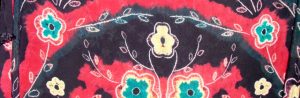
Sasirangan is typical of South Kalimantan cloth that are used as headbands, belts for men, as well as scarves, hoods, and also a traditional tank top for women, although initially it is only intended as a means to complement the therapeutic treatment by the local community elders.In the process of manufacture, the craftsmen apply a dyeing process using a barrier that is sewn with yarn or raffia in order toobtain the desired pattern.Besides obtained from stitching or bonding combinations, the motifs and patterns of also heavily influenced by the color composition created.Here we give the complete process of making the Sasirangan.
1.   Preparing A White Cloth
The first step in making Sasiranganis to prepare a plain white fabric material according to the desired size. At its initial appearance, the raw materials used to make the Sasirangan is typical of cotton fibers, but as time goes by, today the craftsmen tend to use other materials such as santung, balacu, KACI, king, satin, polyester, rayon, and silk.
2.   Making The Design of Patterns On the Fabrics
The second step is to draw the traditional pattern in accordance with the desired motif.The patterns is then used as a benchmark to sew the cloth.
3Â Â Â Â Â Sewing baste
Furthermore, these patterns aresewn stitch together using thread or other barrier material at a distance of one to two millimeters or two to three millimeters.Those threads contained in each pattern stitches are then drawn to form some wrinkles.
4.    Washingthe fabric
If the fabric used to make Sasirangan containssome starch, it must be first cleaned by immergeit within cold water that has been mixed with chlorine for one night.
5.    Fabric Dyeing
There are at least three ways of coloring sasirangan, they aredyeing, dabbing, as well as a combination of both (dyeing and dabbing).
a). Â Dyeing technique is used to obtain a single color. It is done by dipping the fabric into the dye fluid, except at the parts that have been sewn stitch. Those parts will have to remain white.
b). Â Dabbing technique is usually done to obtain more than one color.
c). Dyeing and dabbingtechniques are used to obtain a good base color. The fabric must be dyed first then it is dabbed  withthe desired color variations.
6.    Removing The Baste Stitches
Furthermore when the fabric is considered to dry, the threads used to stitch or bond the fabric are then removed entirely. The motifs will appear between those stitches.
7.    Washing the cloth
After the entire barrier is released, the cloth is washed thoroughly with water. The washing process is stopped if there is no more color residue found in water.
8.     Drying the cloth
The next stage isto dry the clothunder the shade and not to expose it to direct sunlight.
9. Â Â Â Finishing / ironed
As the final refinement of the manufacturing process of Sasirangan, the cloth is then ironed to make it smooth, slick and neat.